Whether you are applying for a job, starting a business partnership, freelancing, or investing your time in a project, checking if a company is genuine is an important first step. Many fake or unreliable companies attract people with attractive offers, only to disappear later or cause financial and legal problems.
Fortunately, you can verify a company’s authenticity by following a few simple steps. This guide explains how to identify a genuine company before you decide to work with it.
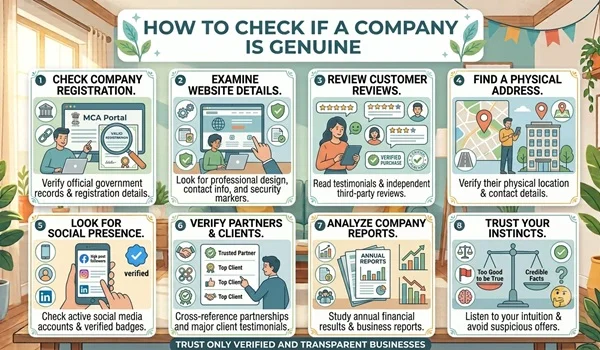
Why Verifying a Company Matters
Working with an unverified company can lead to several problems, such as:
- Financial loss
- Delayed or unpaid salaries
- Fake job offers
- Identity theft
- Poor working conditions
- Legal disputes
- Damage to your professional reputation
Taking a little time to verify a company can help you avoid these risks.
Check the Company’s Official Website
A genuine company usually has a professional website that includes important information, such as:
- Company history
- Products or services
- Contact details
- Office address
- Leadership team
- Privacy Policy and Terms of Service
Look for spelling mistakes, broken links, or incomplete information. A poorly maintained website may be a warning sign, especially if the company claims to be well established.
Verify Business Registration
One of the best ways to check whether a company is genuine is to verify its registration.
In India, you can check if a company is registered with the Ministry of Corporate Affairs (MCA). The registration details usually include:
- Company name
- Corporate Identification Number (CIN)
- Date of incorporation
- Registered office address
- Company status
- Directors’ names
If a company claims to be registered but no official record exists, proceed with caution.
Check the Company’s Physical Address
A legitimate business generally has a real office address.
You can:
- Search the address on Google Maps
- Check Street View (where available)
- Verify whether the office exists
- Look for photos and reviews of the location
Be careful if the company only provides a P.O. Box or refuses to share its office address.
Look for Contact Information
A trustworthy company usually provides multiple ways to contact them, including:
- Business email address
- Phone number
- Office address
- Customer support
Be cautious if the company only communicates through messaging apps or personal email accounts.
Read Online Reviews
Customer and employee reviews can provide useful insights.
Check reviews on:
- Google Business Profile
- Glassdoor
- Indeed
- Trustpilot
- Social media pages
Do not rely on a single review. Instead, look for common patterns such as repeated complaints about delayed payments, poor communication, or fake promises.
Check Social Media Presence
Most genuine companies maintain active social media profiles.
Look for:
- Regular posts
- Customer interactions
- Company updates
- Employee activities
- Verified business accounts where applicable
A company with no online presence is not necessarily fake, but it deserves additional verification.
Search for News and Media Coverage
Established businesses often appear in:
- Business news websites
- Industry publications
- Press releases
- Award announcements
- Event participation
A simple online search may reveal useful information about the company’s reputation and recent activities.
Verify GST and Tax Information
If the company operates in India, you can ask for its GST number if relevant to your work or business relationship.
A valid GST registration indicates that the company is registered for taxation under applicable rules.
Review the Company’s Financial Health
If you plan to invest or enter into a long-term business relationship, review the company’s financial position whenever possible.
Consider checking:
- Years in business
- Revenue growth
- Public financial reports (if available)
- Credit ratings
- Outstanding legal issues
Financial stability often reflects how reliable a company may be.
Check Employee Experiences
Current and former employees often share valuable insights.
Look for comments about:
- Salary payments
- Work culture
- Career growth
- Management behavior
- Employee benefits
- Job security
Remember that individual opinions may vary, so focus on recurring themes rather than isolated complaints.
Verify Business Licenses
Some industries require specific licenses or certifications.
Examples include:
- Healthcare
- Financial services
- Education
- Manufacturing
- Food businesses
If the company operates in a regulated industry, ensure it holds the required approvals.
Watch for Common Warning Signs
Certain red flags may indicate that a company is not genuine.
Unrealistic Job Offers
Be cautious if a company promises:
- Extremely high salaries for simple work
- Guaranteed promotions
- Instant hiring without interviews
Upfront Payment Requests
A legitimate employer usually does not ask candidates to pay money for:
- Job offers
- Training
- Registration
- Equipment deposits
No Written Agreement
Always request a written offer letter or contract before starting work.
Poor Communication
Frequent delays, inconsistent information, or evasive answers may indicate an unreliable organization.
Pressure to Make Quick Decisions
Scammers often create urgency by saying:
- “Offer expires today.”
- “Pay immediately.”
- “Join within a few hours.”
Take your time to verify the company before making any commitment.
Ask Questions Before Joining
Do not hesitate to ask questions such as:
- How long has the company been operating?
- What products or services does it offer?
- Who are its major clients?
- What are the job responsibilities?
- What is the salary payment schedule?
- Is there a written employment contract?
Professional companies generally answer these questions clearly.
Verify the Employment Contract
Before accepting an offer, carefully read the employment agreement.
Check for:
- Salary details
- Working hours
- Notice period
- Leave policy
- Benefits
- Confidentiality clauses
- Termination conditions
If anything seems unclear, ask for clarification before signing.
Compare Information Across Multiple Sources
Never rely on a single source.
Cross-check information from:
- Official website
- Government records
- Online reviews
- Social media
- Business directories
- News articles
Consistent information across multiple sources increases confidence in the company’s authenticity.
Quick Checklist Before Working With Any Company
| Verification Step | Why It Matters |
| Check official website | Confirms business presence |
| Verify company registration | Confirms legal existence |
| Confirm office address | Ensures physical presence |
| Read online reviews | Reveals customer and employee experiences |
| Verify contact details | Shows business transparency |
| Check social media | Indicates active operations |
| Review financial stability | Helps assess long-term reliability |
| Verify licenses | Confirms regulatory compliance |
| Read employment contract | Protects your legal rights |
| Watch for red flags | Helps avoid scams |
Final Thoughts
Verifying a company before working with it is a smart and responsible step. Checking business registration, reviewing online feedback, confirming contact details, and carefully reading contracts can help you identify trustworthy organizations and avoid common scams. Spending a little time on research today can save you from financial losses, legal issues, and unnecessary stress in the future.